

Artificial intelligence is changing how small businesses operate. From categorizing expenses and processing invoices to preparing financial reports, AI-powered tools are making everyday accounting tasks faster and more convenient.
But as more financial responsibilities become automated, an important question arises: Who's making sure the numbers are actually right?
A November 18, 2026, report from Thomson Reuters highlights a growing concern for small businesses: AI adoption is moving quickly, but the systems needed to monitor accuracy, protect financial information, and maintain accountability aren't always keeping pace.
For business owners, the goal shouldn't be to avoid AI. It's to understand where automation helps, where it can create risks, and when professional oversight matters most.
AI Is Changing Small Business Accounting
AI-powered accounting software can now help businesses manage tasks that previously required hours of manual work.
Common applications include:
Automatically categorizing business transactions
Extracting information from invoices and receipts
Identifying unusual expenses or transactions
Generating cash flow summaries and financial reports
Assisting with bookkeeping and account reconciliation
Organizing financial information for tax preparation
These capabilities can reduce administrative work and give business owners faster access to financial information.
However, automating a financial task doesn't automatically guarantee its accuracy.
An expense can be categorized incorrectly. An invoice can be duplicated. A financial summary can overlook important information.
And when those errors go unnoticed, they can affect business decisions.
The Hidden Risk: When AI Gets the Numbers Wrong
One challenge with AI-generated financial information is that results can appear accurate even when something is missing or incorrect.
Consider a business owner reviewing an automatically generated monthly expense report.
The software may have categorized certain purchases as deductible business expenses. But whether those expenses qualify for a tax deduction depends on the facts, the nature of the business, and applicable tax rules.
Without proper review, the owner might rely on those classifications when estimating taxable income or making financial decisions.
Similar issues can arise when AI is used to:
1. Categorize business expenses
Not every business purchase receives the same accounting or tax treatment. Incorrect classifications can affect financial statements and tax reporting.
2. Analyze cash flow
A cash flow projection is only as reliable as the information and assumptions used to prepare it. Missing liabilities, anticipated expenses, or unusual transactions can create misleading forecasts.
3. Assist with payroll
Payroll involves more than calculating wages. Employee classifications, deductions, tax withholding, and reporting requirements all require accuracy.
4. Support tax preparation
AI can assist with organizing records and researching tax topics, but its responses may contain outdated information, incorrect interpretations, or incomplete guidance.
These risks don't mean AI lacks value. They mean automated results should be reviewed according to the consequences of getting them wrong.
The IRS Has Also Addressed AI Accountability
In June 2026, the IRS Office of Professional Responsibility issued guidance on the responsible use of generative AI in federal tax practice.
The guidance addresses concerns involving inaccurate AI-generated information, taxpayer confidentiality, and professional responsibility.
It emphasizes that tax professionals must maintain appropriate competence, verify AI-assisted work, and protect sensitive client information.
Importantly, using AI does not eliminate a tax professional's responsibility to exercise independent judgment.
For business owners, this reinforces a practical point: AI can support accounting and tax-related work, but it shouldn't be treated as a substitute for qualified professional review.
What Should Business Owners Review Before Trusting AI?
You don't need a large technology department to establish sensible safeguards.
Start by asking these five questions:
1. Who reviews AI-generated financial information?
Determine who is responsible for checking automated transactions, reports, and recommendations.
Routine tasks may require periodic checks, while payroll changes, tax filings, and significant financial decisions may warrant closer review.
2. Can the results be verified?
A reliable financial process should allow someone to trace reported amounts back to invoices, receipts, bank transactions, or other supporting documentation.
If a result cannot be explained or verified, it shouldn't be accepted solely because it came from an automated system.
3. Is sensitive financial information protected?
Before uploading financial records or connecting an AI tool to accounting systems, understand how the provider handles data.
Review access permissions, retention practices, security features, and whether information may be shared or used for other purposes.
4. Are accounting records regularly reconciled?
Automation can help identify and organize transactions, but regular reconciliations remain essential.
Comparing accounting records with bank statements and other supporting documents can help detect missing entries, duplicates, and errors.
5. When should a CPA get involved?
Certain matters call for professional analysis rather than automated recommendations alone.
Examples include business tax planning, unusual transactions, financial statement review, entity-related tax questions, and major financial decisions.
Recognizing when expert guidance is needed can help prevent small mistakes from becoming larger problems.
AI and CPAs: Why Businesses Benefit From Both
The future of small business accounting doesn't have to be a choice between technology and professional expertise.
Both can serve valuable purposes.
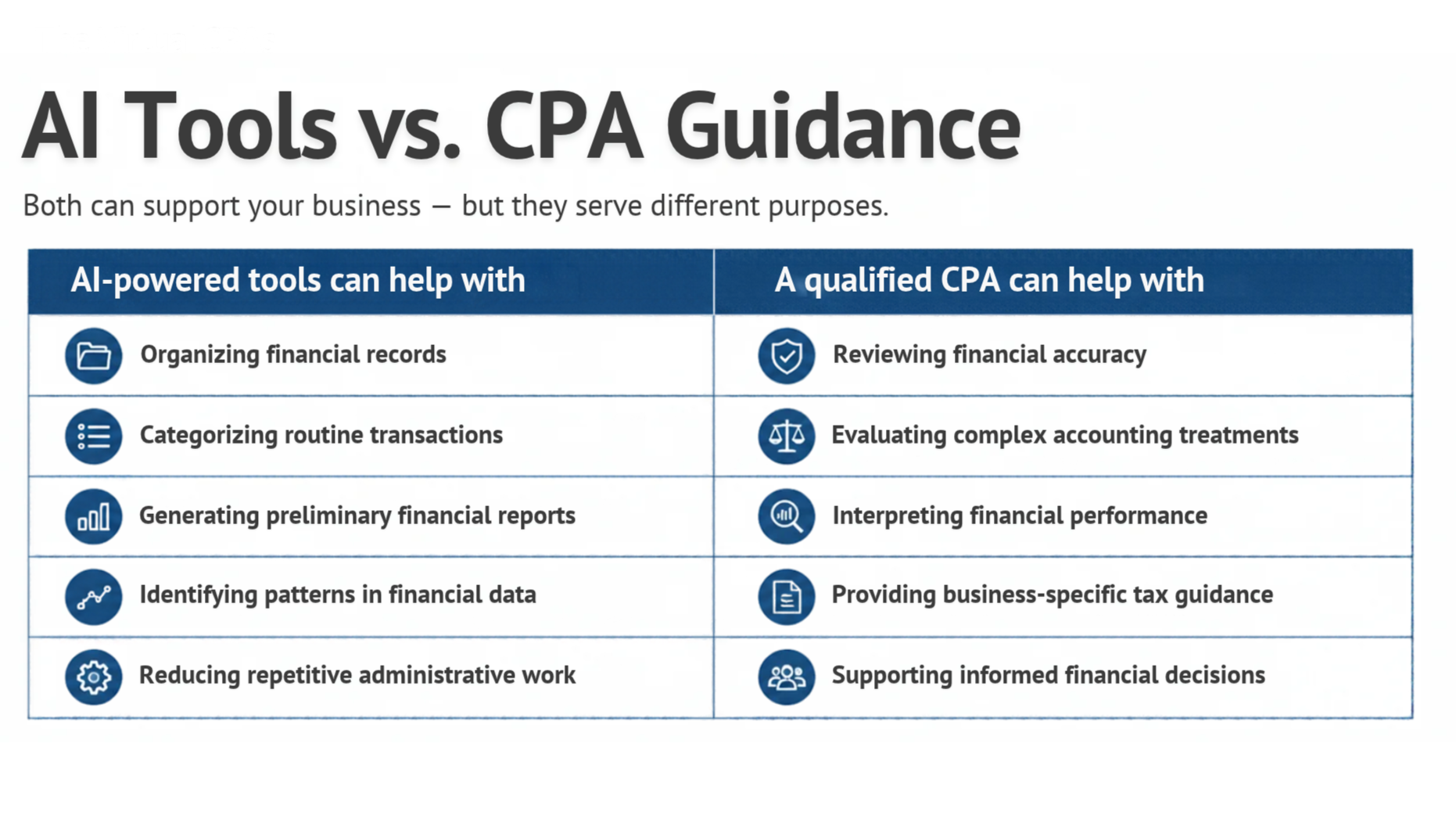
AI-powered tools can help withA qualified CPA can help withOrganizing financial recordsReviewing financial accuracyCategorizing routine transactionsEvaluating complex accounting treatmentsGenerating preliminary financial reportsInterpreting financial performanceIdentifying patterns in financial dataProviding business-specific tax guidanceReducing repetitive administrative workSupporting informed financial decisions
AI can help make financial information more accessible. Professional accountants can help business owners understand what that information means and how it applies to their circumstances.
The combination can support more efficient processes without sacrificing appropriate financial oversight.
Make Your Technology Work for Your Business
As businesses continue adopting AI, now is a good time to review how technology fits into existing accounting processes.
Consider starting with these steps:
Identify which bookkeeping and financial tasks are currently automated.
Establish clear responsibilities for reviewing automated results.
Make sure important transactions have adequate supporting documentation.
Review how financial information is accessed, stored, and protected.
Consult a qualified accounting professional before relying on AI-generated recommendations for significant tax or financial decisions.
The goal isn't to manually redo every automated task. It's to establish appropriate checks so automation can deliver meaningful value.
The Bottom Line: Automation Should Support Better Decisions
AI is becoming an increasingly useful part of small business financial management. It can save time, simplify workflows, and help business owners access information more efficiently.
But financial accuracy, accountability, and good judgment remain essential.
The real advantage isn't simply having faster numbers. It's having reliable information you can confidently use to run your business.
Get Clarity and Confidence in Your Business Finances
At Virtual CPAs, we believe business owners deserve more than financial reports. They need reliable information, practical guidance, and a clear understanding of their financial position.
Whether you're reviewing your accounting processes, planning for taxes, or making important business decisions, professional guidance can help you move forward with greater confidence.
Talk with Virtual CPAs and get expert tax and accounting guidance.
This article provides general educational information and is not individualized tax, accounting, or legal advice.